
Compounding Calculator

Subscribe and get a discount coupon 🎁

Subscription Form

Compounding Calculator

Use this forex compounding calculator to see how an account grows when you keep the profit in the account instead of withdrawing it. Set a starting balance, a gain per period and the number of periods, and the curve then does the rest, because compounding rewards patience far more than it rewards big risk.

What is a Compounding Calculator

Starting balance: This represents the initial account equity. Let’s use, for our example, a starting balance of 1,000 units of any deposit currency.

Number of periods: In this field traders can simulate a winning streak of x consecutive winning trades. Please note: the period is every time you receive an interest on holdings, or, close a trade in profit, etc. For example:

Let’s use, for our example, a series of 6 consecutive winning trades.

Gain % per period: The crucial field of the calculator, used to simulate the gain percentage per any period of compounding. It can be used by the trader who does 5 daily trades with a target of 0.05% return per trade. It can also be used by a trader doing 5 weekly trades and targeting 1% return per trade, even a long-term trader, doing 12 trades per year and targeting 5% return per trade. For our example we will use a gain percentage per period of 2%.

Then, we hit the “Calculate” button.

The results: “The Ending Balance” after compounding the gains of 6 consecutive winnings and the “Total Gain” percentage. For this case, an initial equity of 1,000 units, of any account currency, after compounding the gains of 6 consecutive winnings, is now 1,126.16 units.

This means that by compounding just 6 winning trades and taking a low profit percentage of only 2% per trade, the account balance has grown by 12.6%.

On the results above there’s also a detailed breakdown of how each compounded trade increased the account balance, how much each compounded trade is in total percentage and the ending account balance.

How the forex compounding calculator turns small gains into a curve

Basically, compounding is the profit of one period joining the capital of the next. Because the base keeps growing, the same percentage earns more money every time, and the line on the chart bends upwards instead of running straight.

For example, 1,000 units gaining 2 percent per period becomes 7,245 after a hundred periods. The same account at 3 percent reaches 19,219, and at 5 percent the arithmetic reaches 131,501. Consequently, a very small change in the gain per period produces an enormous change at the end, which is exactly why the number you type matters more than it looks.
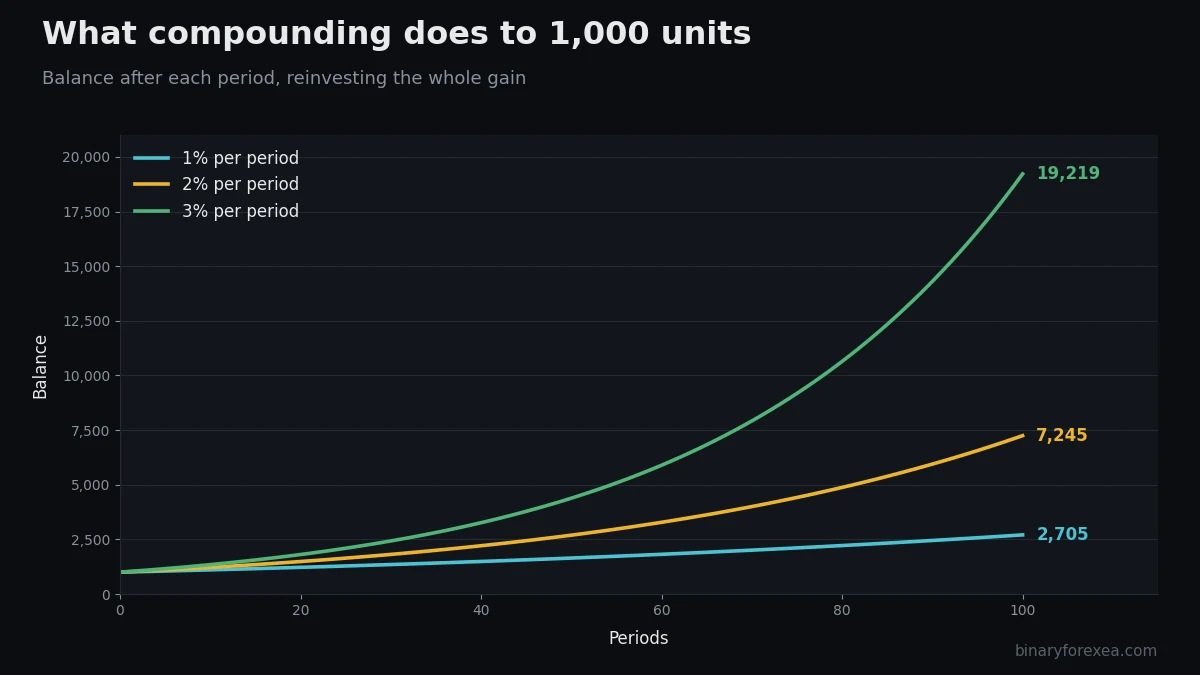

Forex compounding calculator chart with the growth of a 1,000 account at 1, 2 and 3 percent per period
One percent per period turns 1,000 into 2,705 over a hundred periods, and three percent turns it into 19,219.

Forex compounding calculator table for a 1,000 unit account

Of course, every figure below starts from 1,000 and reinvests everything.

Gain per periodAfter 50 periodsAfter 100 periodsAfter 200 periods
1%1,6452,7057,316
2%2,6927,24552,485
3%4,38419,219369,356
5%11,467131,50117,292,580

Obviously that last figure is arithmetic, not a forecast. No account compounds 5 percent two hundred times in a row, because losing periods arrive, position sizes hit broker limits and the market stops cooperating. Still, the shape of the table is the real lesson: patience beats aggression over any serious number of trades.

Why the forex compounding calculator is honest and the screenshots are not

Naturally, the calculator assumes every period gains exactly the same percentage. Reality of course does not work that way, and three things break the curve.

  • Losing runs. For example, one bad streak resets the base, and you then compound from a smaller number. Check the damage in the drawdown calculator before you believe any curve.
  • Withdrawals. Besides, most traders take money out, which is sensible, yet every withdrawal flattens the curve permanently.
  • Lot size steps. Brokers trade in steps of 0.01 lots, so a small account cannot size perfectly and the real gain drifts away from the model.

How to use the forex compounding calculator without fooling yourself

First of all, enter the gain per month rather than per trade, and use a number you have actually produced, not the one you hope for. Between 2 and 5 percent a month is a serious professional result, while 20 percent a month is a marketing slide.

Then run the same period count again with one bad month subtracted, since that is what the year really looks like. Finally, size the individual trades with the lot size calculator so a single position can never undo a month of compounding. Investopedia explains the underlying compound interest maths in detail.

Forex compounding calculator questions traders ask

Should the period be a trade, a day or a month? Generally, use whichever one you can measure honestly. Months are usually best, because a month already contains the losing days.

Does compounding work with a fixed lot size? Certainly not, and that is the point. If you never raise the volume, the account grows in a straight line instead of a curve. Therefore the volume has to follow the balance.

Is compounding risky? In itself, certainly not. However, raising the lot size after every win also raises the money at risk, so keep the risk percentage constant and let the lots follow it.

What gain per month is realistic? Above all, consistency beats size. A trader who makes 3 percent a month for three years finishes far ahead of one who makes 30 percent twice and then blows up, as the risk of ruin calculator shows rather brutally.

We Accept

Home

© binaryforexea.com - Todos los derechos reservados

binaryforexea.com © All rights reserved

Updated in September 2026

%
Earn 30%
Affiliate program
Promote our EAs. Free to join.
Join now  →
COPY OUR
TRADES NOW
● LIVE GOLD SIGNAL
 LIVE GOLD SIGNAL +--% total gain Win --% · PF -- Copy it now → </> MQL4 & MQL5 FREE
SOURCE CODES
Download now →
Assistant 🔊 – ✕
← My conversationsEnd chat
Scroll to Top