
Ambush, the previous week high low MT5 indicator that waits in the bushes
Last week left four prices that everybody can see: its high, its low and the range in between. Orders and stops collect around them, and the first time price reaches one of those levels this week, the reaction is usually violent. Ambush is a previous week high low MT5 indicator that draws those levels and fires when price runs past one and gets thrown straight back.
The arrow does not repaint, does not move and does not disappear. It needs a closed candle, and once it prints it stays exactly where it printed.
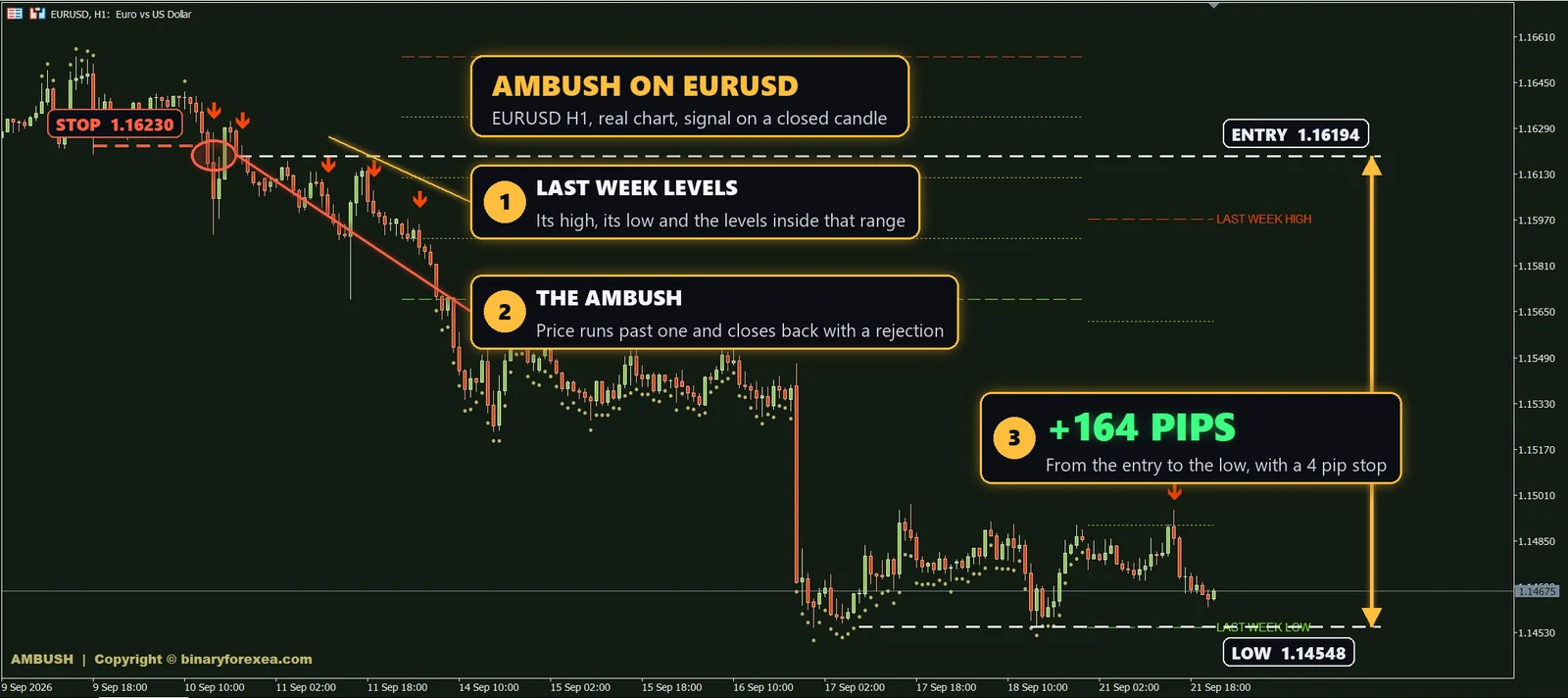 Click the image to enlarge
Real chart, EURUSD on H1. The dashed lines are last week’s high and low, and the dotted ones are the levels inside that range. Price pokes above one of them, leaves a rejection wick and closes back below it. The sell arrow prints at 1.16194 with the stop on the tip of the wick at 1.16230, a risk of only 4 pips. From there the euro fell to 1.14548, a move of 164 pips. Every price comes from the exact candle history of that chart.
Why last week still moves this week
A weekly high is where the market ran out of buyers, so the traders who sold there remember the price and the ones who are long keep their stops just above it. That makes those levels real support and resistance, not lines drawn for decoration.
However, price touches levels constantly, and most touches mean nothing. Therefore Ambush only counts the ones where the candle pushes through, gets rejected with a real wick and closes back on the correct side. That rejection is the whole signal.
What Ambush checks before it fires
- The levels. Last week’s high, its low, the middle of the range and the quarters, all frozen when the week changes.
- The raid. The candle has to go beyond the level, not just touch it.
- The rejection. It must close back on the other side, with a wick of real size pointing at the level.
- No fighting itself. After a signal, the opposite side stays locked until price has really turned, so you never get a buy and a sell next to each other.
As a result the chart stays readable, with two or three clean signals a day on the lower timeframes.
How to trade the previous week high low MT5 signals
- Enter on the close of the arrow candle. The level already did its job.
- Stop on the tip of the wick. That is why the risk is so small on these trades.
- Target the next level. They are all drawn, so your first target is on the chart before you enter.
- Respect the week. Also, a rejection at the weekly high while price spends the week below it is worth more than one in the middle of the range.
Markets and timeframes
| EURUSD | H1, the example above |
| Gold XAUUSD | M15 and H1 |
| All major pairs | M15 to H1, the same rules |
This previous week high low MT5 tool suits intraday charts, because weekly levels matter most while the week is still developing. In practice, M15 gives activity and H1 gives the cleanest rejections.
What is inside
- Last week’s high, low, middle and quarter levels, labelled on the chart.
- Rejection arrows on closed candles only. They do not repaint, move or disappear.
- Editable wick share, bars between signals and the distance the opposite side must wait.
- Popup, sound, push and email alerts, each one switchable.
- Premium dark chart theme, applied on attach and restored on remove.
Besides, it reads price only, so any broker and any account works. If you want robots that trade by themselves, browse our automated robots, and the rest of the manual set is in our chart tools for traders.
Questions about this previous week high low MT5 indicator
Does it repaint? No. The levels come from a week that already finished and the arrow needs a closed candle.
Why are my levels different from another platform? Because brokers start the week at different hours. The rule is the same, the first candle is not.
Can I use only the high and the low? Yes. Switch off the inner levels and the tool works with the two classic lines alone.
Do you have the other version? Yes. This is the MetaTrader 5 build, and Ambush for MT4 draws the same levels on MetaTrader 4.
Trading involves risk. Signals are information, not advice, so try any new tool on a demo account first and only trade money you can afford to lose.